Any of you out there struggling with the not knowing how long this isolation and interruption of normal life will last? My family definitely is.
There are lots of ways we are coping with this. We all need things to do and things to look forward to. An opportunity came up for us at the end of the week. My twins are in an online class with our homeschool co-op and this week in class, the students made a goal to collectively read 1 million pages in the next 8 weeks. There are about 10 students in the class. Do the math. That's probably not possible for 10 middle-grade students (or any 10 people) to do in 8 weeks. Recognizing this, but not wanting to discourage this reading enthusiasm, the teacher decided to invite all the families of LEAF to participate along with these students and contribute to their goal. Between all of us (There are nearly 100 of us), we have a chance of pulling it off. Especially since we all have so much time to read.
It's exciting to have a big goal to work on now! And getting lost in stories is such a healthy escape from all the anxiety of the moment. Working on this big goal together will help us all become better readers, help us feel connected to each other, give us something to think about besides the current crisis, give us all something worthwhile to do, and ultimately, it will be fun!
Is there a big goal you've thought about doing but not found the time for yet? This is the time! Nothing is too big to consider. Obviously there are some limits related to the current crisis (probably not the time to tour all 50 states) but there is sooooo much we can do right now. What will you do with this opportunity?
Showing posts with label Homeschool. Show all posts
Showing posts with label Homeschool. Show all posts
Saturday, March 21, 2020


Friday, March 20, 2020
Token System
Let me just preface this post with the following. I'm about to share some really detailed, specific information. This is not for everyone. I definitely don't think everyone needs or wants this. But for some of you it might be really, really helpful. I have found it so. That's why I'm sharing it.
My son is on the high functioning end of the Autism Spectrum, has severe ADHD, and has learning disabilities. His twin sister has pretty severe ADHD and learning disabilities. Parenting and teaching these kids is not easy. Let's be honest, parenting and teaching any child is not easy. Period. Several of my kids therapists have recommended a token system to help things go better. My family has really benefited from using a token system. It is a scientific, research-based method for helping kids gain skills and change their behavior.
I am not a professional. I'm probably making all kinds of mistakes. Even so, this is really working for us. I am going to share how my family uses a Token System in hopes that maybe someone else could benefit from it too.
Ultimately a token system is pretty simple. You need 3 things.
1. A list of behaviors you want to see from your kids. When they do these things, they earn tokens.
2. A list of privileges and stuff kids can spend their tokens on.
3. Tokens. Some students, especially older students will benefit from a virtual points system and don't require physical tokens but younger students and especially those with neuro-atypical brains will do best using concrete, physical tokens.
List of Desired Behaviors
Here's my list. Yours will be different.
When first introducing a token system, it might work better to keep the list of desired behaviors small - like 5 things. It would be ideal for kids to be maxing out the list and asking for more ways to earn tokens. Sometimes it's hard to think small. Think of one behavior you'd really like to see. Imagine how awesome it would be see that one thing change. You're more likely to see it change if you don't put it on a list with 30 other behaviors.
It's also critical that you focus on behavior you want, not on behavior you don't want. Otherwise you will be promoting what you don't want. If I say don't think of a pink banana, what do you think of? Difficult to think of anything else and so you fail. If however I say, think of a purple frog, you can do that, right? At meal times, one of my children tends to touch, kick, hit, and bug others at the table. So we ask that child to keep their hands and feet to themselves rather than focusing on what we don't want them to do.
For the record, I haven't figured any of this stuff out myself. It was all taught to me by my kids therapists.
List of Privileges and Stuff to Earn
It is important all privileges (things you would not consider fundamental needs) be earned. If it's only nice-to-haves that they must earn, most kids won't be motivated to earn them. A good way to differentiate between fundamental needs and wants is to ask, will I go crazy if they don't earn X? At our house, trampoline time is a fundamental need.
Kids should spend the majority of their tokens every day on stuff they really want. They can save a small portion for a bigger item if they want to.
These are things my kids can spend their tokens on
Tokens
 Here's what I use. $13.99 for 900 bingo chips on amazon. Anything small and light weight could work. You could make your own.
Redeeming Tokens
I was surprised by how much time and energy goes into this part of the system. I have not discussed this part so much with therapists, just figured out what would work for us. I might be doing it all wrong. I'm ok with that. My kids are not allowed to redeem tokens until after we finish chore time each day. It can be difficult to keep track of what they have earned. My brain is pretty full already.
So, at various points in the day (basically after we finish one of our mini routines like breakfast, school time, chore time etc.), I make tally marks on a paper for each child to keep track of tokens they have earned. Then, after chore time, I hand out all the tokens.
Tokens are truly money at our house and my kids struggle with impulse control so I keep tokens with me, safely in sight but out of reach of kids, or locked up, all the time. Yes, it's a pain. But it's worth it.
Break it Down
When I first gave my kids the big list of ways to earn tokens, they were totally overwhelmed and not even a little bit motivated to do it. They also both struggle with what is called executive function. They need help breaking big tasks down and planning how to complete them.
So I broke our day up into several mini-routines and typed up all the things they should do for that mini-routine. All the things earn them tokens. We started with just one mini-routine - the morning, pre-breakfast routine. I gave them each a laminated print out of the routine and asked them to come to me as they completed things on the list so I could mark it off. Once the morning routine was a habit we added the next mini-routine. We now have routines for Morning, Breakfast, School Time, Lunch Time, Chore Time, Afternoon, Evening, and Bedtime. No we don't do it all, probably ever, and we sometimes don't do any of it. But most of the time, we do most of it, and we are all happier.
Here's an example of a mini-routine. This is my kids morning routine and they can earn tokens for all of it.
Give it Time
It has taken us months to get our system working smoothly and we continue to refine/update/change it as we go. If it's not working, simplify.
My son is on the high functioning end of the Autism Spectrum, has severe ADHD, and has learning disabilities. His twin sister has pretty severe ADHD and learning disabilities. Parenting and teaching these kids is not easy. Let's be honest, parenting and teaching any child is not easy. Period. Several of my kids therapists have recommended a token system to help things go better. My family has really benefited from using a token system. It is a scientific, research-based method for helping kids gain skills and change their behavior.
I am not a professional. I'm probably making all kinds of mistakes. Even so, this is really working for us. I am going to share how my family uses a Token System in hopes that maybe someone else could benefit from it too.
Ultimately a token system is pretty simple. You need 3 things.
1. A list of behaviors you want to see from your kids. When they do these things, they earn tokens.
2. A list of privileges and stuff kids can spend their tokens on.
3. Tokens. Some students, especially older students will benefit from a virtual points system and don't require physical tokens but younger students and especially those with neuro-atypical brains will do best using concrete, physical tokens.
List of Desired Behaviors
Here's my list. Yours will be different.
- Take a shower
- Comb or refresh your hair
- Lotion your arms and legs
- Wipe clean the bathroom toilet and floor
- Clean the bathroom mirror, sink, and counter
- Clean your bedroom
- Take your supplements
- Take your medication
- Go around the house and pick up all your stuff
- Help make breakfast
- Sit at the table for the entire meal
- Keep your hands and feet to yourself for the entire meal
- Come to school time when called, without any toys
- Do a meditation
- Write a school plan for the day
- Complete your school plan for the day
- Practice violin or viola
- Practice dance
- Help make lunch
- Do a chore
- Get pajamas on
- Brush your teeth
- Participate in SSR
When first introducing a token system, it might work better to keep the list of desired behaviors small - like 5 things. It would be ideal for kids to be maxing out the list and asking for more ways to earn tokens. Sometimes it's hard to think small. Think of one behavior you'd really like to see. Imagine how awesome it would be see that one thing change. You're more likely to see it change if you don't put it on a list with 30 other behaviors.
It's also critical that you focus on behavior you want, not on behavior you don't want. Otherwise you will be promoting what you don't want. If I say don't think of a pink banana, what do you think of? Difficult to think of anything else and so you fail. If however I say, think of a purple frog, you can do that, right? At meal times, one of my children tends to touch, kick, hit, and bug others at the table. So we ask that child to keep their hands and feet to themselves rather than focusing on what we don't want them to do.
For the record, I haven't figured any of this stuff out myself. It was all taught to me by my kids therapists.
List of Privileges and Stuff to Earn
It is important all privileges (things you would not consider fundamental needs) be earned. If it's only nice-to-haves that they must earn, most kids won't be motivated to earn them. A good way to differentiate between fundamental needs and wants is to ask, will I go crazy if they don't earn X? At our house, trampoline time is a fundamental need.
Kids should spend the majority of their tokens every day on stuff they really want. They can save a small portion for a bigger item if they want to.
These are things my kids can spend their tokens on
- 1 playmobil piece or lego piece from a set (they earn 1 piece of a set at a time, in the order the pieces are listed/shown in the instructions)
- Watch an episode of educational TV
- Watch an episode of TV
- Look on amazon (for stuff they want to earn) with Mom or Dad for 5 min.
- Watch a YouTube video with Mom or Dad
- Ride bike outside
- Use of shuffle/mP3 player for the day
- Use of kindle for the day
- Watch a movie
- Purchase a TV episode on amazon
- Rent a movie on amazon
- Purchase an audiobook
- Buy a toy, lego set, or playmobil set
- Buy a new kindle
- Go on a big outing (not really an option rightnow)
Tokens
 Here's what I use. $13.99 for 900 bingo chips on amazon. Anything small and light weight could work. You could make your own.
 Redeeming Tokens
I was surprised by how much time and energy goes into this part of the system. I have not discussed this part so much with therapists, just figured out what would work for us. I might be doing it all wrong. I'm ok with that. My kids are not allowed to redeem tokens until after we finish chore time each day. It can be difficult to keep track of what they have earned. My brain is pretty full already.
So, at various points in the day (basically after we finish one of our mini routines like breakfast, school time, chore time etc.), I make tally marks on a paper for each child to keep track of tokens they have earned. Then, after chore time, I hand out all the tokens.
Tokens are truly money at our house and my kids struggle with impulse control so I keep tokens with me, safely in sight but out of reach of kids, or locked up, all the time. Yes, it's a pain. But it's worth it.
Break it Down
When I first gave my kids the big list of ways to earn tokens, they were totally overwhelmed and not even a little bit motivated to do it. They also both struggle with what is called executive function. They need help breaking big tasks down and planning how to complete them.
So I broke our day up into several mini-routines and typed up all the things they should do for that mini-routine. All the things earn them tokens. We started with just one mini-routine - the morning, pre-breakfast routine. I gave them each a laminated print out of the routine and asked them to come to me as they completed things on the list so I could mark it off. Once the morning routine was a habit we added the next mini-routine. We now have routines for Morning, Breakfast, School Time, Lunch Time, Chore Time, Afternoon, Evening, and Bedtime. No we don't do it all, probably ever, and we sometimes don't do any of it. But most of the time, we do most of it, and we are all happier.
Here's an example of a mini-routine. This is my kids morning routine and they can earn tokens for all of it.
- Shower
- Lotion Arms and Legs
- Get dressed
- Comb or refresh hair
- Brush teeth
- Make bed
- Clean room
- Bathroom chores
- Personal laundry
- Come to the table for breakfast
Give it Time
It has taken us months to get our system working smoothly and we continue to refine/update/change it as we go. If it's not working, simplify.
Wednesday, March 18, 2020
Read Aloud and SSR
How is your homeschool going? I know I shared A LOT of detailed information in my earlier post on emergency homeschooling and I stand by it but it was meant to be a menu of options, not a checklist and I fear many people are struggling with overwhelm right now.
I want to focus on two very simple things you can do to make your homeschooling incredible. SO MUCH research backing this up. This is not just my opinion. It is proven fact. Focus JUST on these two things and your homeschool will accomplish more than any other school ever has. Truly.
1. Read Aloud
2. SSR/DEAR
Read Aloud
If you want convincing, read The Read Aloud Handbook by Jim Trelease. 5 minutes of Read Aloud counts and will make a difference. If you are a working parent and all you can manage is 5 minutes, don't despair, it counts. It will make a significant difference.
Audio Books Count
This is the easiest way to do read aloud. Play audiobooks on a kindle, phone, tablet, amazon Alexa, whatever and let the kids play with legos, playmobil, puzzles, coloring, drawing, painting, etc. while they listen. Be really flexible. Keep trying out ways to make this work until you figure out the best way for your family. My kids do best with individual kindles and headsets so they can each listen to what they want. But our family enjoys sharing a book too, especially in the car.
SSR
SSR stands for Sustained Silent Reading. Another variation is DEAR or Drop Everything and Read. The research is stunning. Failing schools have been turned around in months, student scores have soared, the summer slump has been overcome, all due to SSR. 15 minutes/day is all it takes. But most people will want to keep going.
Read The Read Aloud Handbook by Jim Trelease and The Book Whisperer by Donalyn Miller for convincing.
The keys are:
1. EVERYONE in the home/family/space you are in does it.
2. Each person CHOOSES what they want to read. No assigned content.
3. Make it SHORT like 15-20 minutes. Then if anyone wants to continue, they can but DON'T require it. Let people fall in love with reading.
Seriously, just focus on Read Aloud and SSR and you will be stunned by the results.
I want to focus on two very simple things you can do to make your homeschooling incredible. SO MUCH research backing this up. This is not just my opinion. It is proven fact. Focus JUST on these two things and your homeschool will accomplish more than any other school ever has. Truly.
1. Read Aloud
2. SSR/DEAR
Read Aloud
If you want convincing, read The Read Aloud Handbook by Jim Trelease. 5 minutes of Read Aloud counts and will make a difference. If you are a working parent and all you can manage is 5 minutes, don't despair, it counts. It will make a significant difference.
Audio Books Count
This is the easiest way to do read aloud. Play audiobooks on a kindle, phone, tablet, amazon Alexa, whatever and let the kids play with legos, playmobil, puzzles, coloring, drawing, painting, etc. while they listen. Be really flexible. Keep trying out ways to make this work until you figure out the best way for your family. My kids do best with individual kindles and headsets so they can each listen to what they want. But our family enjoys sharing a book too, especially in the car.
SSR
SSR stands for Sustained Silent Reading. Another variation is DEAR or Drop Everything and Read. The research is stunning. Failing schools have been turned around in months, student scores have soared, the summer slump has been overcome, all due to SSR. 15 minutes/day is all it takes. But most people will want to keep going.
Read The Read Aloud Handbook by Jim Trelease and The Book Whisperer by Donalyn Miller for convincing.
The keys are:
1. EVERYONE in the home/family/space you are in does it.
2. Each person CHOOSES what they want to read. No assigned content.
3. Make it SHORT like 15-20 minutes. Then if anyone wants to continue, they can but DON'T require it. Let people fall in love with reading.
Seriously, just focus on Read Aloud and SSR and you will be stunned by the results.
Monday, March 16, 2020
What Went Well Today?
Today is the first day of homeschooling for thousands of families. Expectations are high and the thought of doing this for weeks on end may seem daunting. The most helpful thing you can do in response is notice what went well today. It will be hard. Your brain will want to focus on everything that didn't go well. Don't fight with your brain. Just acknowledge, "yup, we started an hour later than I planned on", "yup, the kids are mostly fighting with each other", "yup, I really don't know what I'm doing", etc. Then, let it go.
There's a lot of research to verify that we attract more of whatever we focus on. What do you want to attract? Focus on it.
It will be difficult to get your brain to notice it. This might be a wrestle. But you can do it. Look for moments when someone actually does what you asked them to. Is there a moment when one of the kids is doing some actual school work? Did someone smile? At the very least, you showed up, right? Notice what you are doing and that you aren't giving up. There will be way more good happening than you will see at first. Look for it, and you'll see more. Comment on it. That will help your kids brains notice it too. And then you'll get more of it.
I'm 100% positive lots of good stuff is happening in your home today. Notice that stuff and you'll get more of it.
There's a lot of research to verify that we attract more of whatever we focus on. What do you want to attract? Focus on it.
It will be difficult to get your brain to notice it. This might be a wrestle. But you can do it. Look for moments when someone actually does what you asked them to. Is there a moment when one of the kids is doing some actual school work? Did someone smile? At the very least, you showed up, right? Notice what you are doing and that you aren't giving up. There will be way more good happening than you will see at first. Look for it, and you'll see more. Comment on it. That will help your kids brains notice it too. And then you'll get more of it.
I'm 100% positive lots of good stuff is happening in your home today. Notice that stuff and you'll get more of it.
Sunday, March 15, 2020
Structure Time Not Content
As mentioned in my post about mitigating anxiety, routines are really important. All of our routines have been blown up by coronavirus. Parents who used to leave the house every day for work are now working from home, working different hours, or not working at all. Kids who used to go to school, appointments, team practices, and lessons are now home all the time. Families who used to go to church on Sundays are now worshiping at home instead. There's hardly any differentiation between the hours of the day or the days of the week. It has so many of us feeling untethered and anxious.
It is time to establish some new routines. My family is going to spend a lot of time figuring this out today. You don't need to read the rest of this post unless you like all the details of how someone else does it. The important thing is to establish new daily and weekly routines for your family.
Here's what I know we need in our new routines:
Weekly
My family embraces and seeks to apply the principles of Leadership Education. One of the principles is Structure Time Not Content. This principle will guide us as we figure out new routines. My understanding of the principle is that one should designate time for certain kinds of activities but let the actual what be decided day-to-day and possibly even in the moment. Let me show you what this looks like for my family. Remember this is just the way we apply the principle. It's not the "right" way or the only way, it is just our way.
Worship
This is going to be really interesting. We've only done 1 week at home so far. The local congregation of our church will be offering a short live streamed service of some kind on Sunday. Then, the rest is up to us. I'm not sure what it will look like. I think it will include scripture reading, singing hymns, discussion, and maybe watching something inspiring.
School Time
We will have at least 3 hours of school time every weekday. At the beginning of school time, I will help my 11 yo twins write a school plan for the day. There are certain things that must be included in plans every day but the order in which they are done and what resources they use to do these things can vary according to my children's needs and desires. I specifically don't give them a checklist of tasks to complete or they will do it as quickly as possible and the quality will be poor. Instead I require that they spend 3 hours on school work, as defined by me. Some days it might take 5 hours to get 3 hours of school work done.
My 16 yo daughter organizes her own school time with very little help from me. She is in Scholar Phase and has several scholar project classes she is committed to (they've all moved online now) and a lot of homework for each of them. She also works on math, foreign language and her own projects. She makes a weekly plan of when and how to get it all done and I check in with her a few times a week to make sure it is happening. When she needs help or resources to get it done, she comes to me, Dad, or one of her project mentors. She has had several years of practicing and developing scholar skills. She is an advanced scholar and she happens to be a particularly skilled and mature 16 yo. Everything about schooling my twins with their special needs and learning disabilities has been totally different than with her. I expect that trend will continue when my twins transition into scholar phase (hopefully in the next 2-4 years).
Pre-coronavirus, we attended a home school co-op every Friday. Now we are doing classes online.
Saturdays
This has always been a day of relaxing and family fun for us. It still will be. It will just look a little different now. We sleep in, stay in our pajamas longer, mom and dad work on projects, kids play, maybe go to the park. We often watch a movie as a family. And at 8 pm, all kids must be in their rooms while mom and dad have a date downstairs. Our favorite at home date is Quiet Pasta. It's quiet because there are no children present, and we eat pasta, one of our favorite foods. Lately my husband has been making noodles and sauce from scratch. So good! I usually make a dessert for us to share as well. After we eat, we like to watch a TV show or movie together. It's good bonding time and we look forward to it all week.
Family Activities
Especially as our oldest gets closer to leaving the nest, we are realizing our days as a family living under one roof, are limited. Sometimes the demands of family life at this stage seem like they might kill us and at the same time, the thought of this stage of life ending breaks our hearts. So we are trying to make the most of it. One of the ways we do this is family activities. We don't do anything too elaborate. Things like taking a family walk, watching a movie together, having a family dance party. We used to go on outings to museums, parks, libraries, plays etc. but other than parks, we are staying away from public spaces right now.
Counseling and Therapy Appointments
I currently see my counselor online. My son has an ABA therapist that comes to our home twice a week. For now that is continuing and we hope it stays that way. We have stopped going to therapy appointments outside of our home. So far, all the extra time at home feels like a blessing.
Personal Hygiene and Personal Chores
Establishing a wake up time and a time when everyone should be ready for the day is critical to a successful routine. At our house, everyone is supposed to be dressed and ready for the day, sitting at the breakfast table by 8:30 am. What happens more often is, I'm waking kids up, urging them to get in the shower and calling for them to come down to breakfast. They are usually all there by 9 am. But the more consistent I am, the closer we get to the goal. Especially if I have breakfast ready by 8:30, kids can smell it, and they are more likely to show up on time. I also expect my kids to do a few personal chores in the morning. Things like make your bed, clean your room, clean up your part of the bathroom, fold your personal laundry (if there is any ready to be folded). In reality, these personal chores often get done in the afternoon but it's really nice when they are done in the morning.
Meal Time
The benefits of eating family meals together are numerous. Regular, predictable mealtimes are critical for a healthy routine too. My family aims to eat breakfast at 8:30 am, lunch at 12:30 pm, and dinner at 6:30 pm. What actually happens every day is 30-60 minutes later than scheduled but we aim for these times and that's enough to provide structure and predictability to our day. As with so many things in family life, the more consistent and prepared I am, the closer we get to the ideal actually happening. I expect all my kids to help prepare breakfast and lunch. My oldest is responsible for dinner one night/week. I want to train my 11 yos to cook dinner too but we aren't there yet.
Family Devotional
Usually during breakfast time, me and the kids have a devotional together. Dad is already working by that time. It's pretty simple. We read a verse of scripture and discuss it. We might sing a hymn, share something that inspired one of us, or listen to a chapter of scripture.
Meditation Time
I mentioned in a previous post that my family has begun doing meditations every morning to help mitigate anxiety in this time of crisis. We start school time with it. We use the Calm app and do a 10-15 minute meditation together.
Family Work
Every afternoon, after school time, we do chores. In our family, privileges are tied to responsibilities. My oldest has several significant responsibilities including part of laundry, loading and unloading the dishwasher, cooking dinner once/week, and driving siblings to things like dance class or dentist appointments. Obviously she's not doing a lot of driving right now. For the most part, she decides when and how to do her chores. But she isn't able to do the things she wants to for fun if her chores aren't done.
For my twins, we use a token system. I'll write about that in a separate post, later. I require the twins to each do 3 chores per day. What the chores are changes every day, based on what I need them to do. It could be sorting dirty laundry, taking garbage or recycling out, sweeping or vacuuming, clearing and washing the kitchen counters, hand washing dishes, or picking up a messy family room. I decide each day based on what I see that needs doing. And not all at once. Each child is supposed to come to me during chore time and ask "Mom, what's my first chore?" Then I look around and tell them what to do, based on what I see that needs doing. When it's done, it is the child's job to check back with me and ask me to approve what they have done. I frequently ask them to redo part of it or finish something that hasn't been finished adequately. Then they ask me what their second chore is, check back, and then ask for their 3rd chore and check back.
They get tokens for doing each of these steps and they cannot have free time or redeem tokens for privileges until chores are done, even on Saturdays and Sundays. It takes a lot of parental effort to teach kids to work but it is so worth it. On days when my kids do their chores, everything at home looks so much better. And we all feel better in a cleaner house. I will never have a magazine-worthy home to show but it's mostly clean at least half the time and my kids are learning to work. I call that success. (Don't ask me how I feel about it on the days when no one does their chores.)
Free Time
It is important for everyone in the family to have time everyday to do things they want to do, without agenda. At our house kids have freetime in the afternoon after school and chores are done. I encourage my kids to spend this time outside but I generally don't require that. Parents get free time in the evening after kids go to their rooms for the night.
Time outside and Moving
In a previous post I talked about how getting outside and moving helps mitigate anxiety. I'm making this a priority in our routine. At the very least I will go get the mail and invite others with me. At best, we will take a family walk together, adults and teen will exercise (we all prefer different kinds of exercise) and the kids will spend time on the trampoline, at the park, and riding their bikes.
SSR
Did you do SSR (Sustained Silent Reading) when you were a kid at school? Or maybe DEAR (Drop Everything and Read)? This is one of those magical things that seems to good to be true. But I'm telling you, try it and you'll see. We try to do SSR every evening at 7:30. We all (including Dad - this is critical) sit in the family room together and everyone has to choose something they want to read for fun. It can't be on a computer screen. Maybe on a kindle if I trust the reader to actually use it for reading. I set a timer and we read for 15 minutes. The first few times we did it, one of my kids struggled to focus and stay silent, but they are getting it now. The benefits of SSR are truly magical. Like the #1 most impactful thing you can do for education. We're talking, improving test scores and helping students fall in love with learning. More than any class, any activity, any intervention, any therapy, any teaching of any kind, SSR is the best. It's so simple its hard to believe and easy to dismiss. If you want convincing read The Read Aloud Handbook by Jim Trelease and The Book Whisperer by Donalyn Miller. It truly is astounding. Try it. You won't be sorry. It is critical that the adults participate and that everyone chooses what to read- the content can't be assigned.
The End of the Day
It's important for our brains and bodies to get lots of signals when the day is coming to a close and it's important that these signals happen in a predictable, routine way. This will lead to better sleep and reduced anxiety. The sun going down is a nice natural signal. At our house, after SSR, we ask kids to get their PJs on, brush their teeth and then go to their rooms to read, listen to audiobooks, play quietly, draw, etc. Ideally, we would also have family prayer together and maybe do a meditation together. But I'm not gonna lie, as our kids got older they stopped wanting us to tuck them in and the prayer part of the routine went with it. I think we'll work on bringing that back into our evening routine. By 8 pm, kids are expected to stay in their rooms. Mom and Dad have some free time to talk, watch TV, read and be together. Kids lights go out at 10 pm. Mom and Dad try to have lights out by 11 pm. But often it's more like midnight. Some of our kids struggle with falling asleep before midnight which makes it difficult for us to go to sleep too. I think if we focus on following our daily routine, this will become less of a problem.
Bottom line, routines make life smoother. They are essential for mental health and happiness. Work on developing your own.
It is time to establish some new routines. My family is going to spend a lot of time figuring this out today. You don't need to read the rest of this post unless you like all the details of how someone else does it. The important thing is to establish new daily and weekly routines for your family.
Here's what I know we need in our new routines:
Weekly
- At least 3 hours of school time, 5 days/week (M-F)
- 1 day of worship (Sunday)
- 1 day of relaxing, working on projects, and having fun together (Saturday)
- Family activities
- Date night for me and my husband
- Counseling and therapy appointments
- Personal hygiene and personal chores
- Family Devotional (week days)
- Meals
- Mediation
- School time (week days)
- Family work and chores
- Free time
- Time outside and moving
- SSR (15 minutes of sustained silent reading for the whole family)
- The end of the day
My family embraces and seeks to apply the principles of Leadership Education. One of the principles is Structure Time Not Content. This principle will guide us as we figure out new routines. My understanding of the principle is that one should designate time for certain kinds of activities but let the actual what be decided day-to-day and possibly even in the moment. Let me show you what this looks like for my family. Remember this is just the way we apply the principle. It's not the "right" way or the only way, it is just our way.
Worship
This is going to be really interesting. We've only done 1 week at home so far. The local congregation of our church will be offering a short live streamed service of some kind on Sunday. Then, the rest is up to us. I'm not sure what it will look like. I think it will include scripture reading, singing hymns, discussion, and maybe watching something inspiring.
School Time
We will have at least 3 hours of school time every weekday. At the beginning of school time, I will help my 11 yo twins write a school plan for the day. There are certain things that must be included in plans every day but the order in which they are done and what resources they use to do these things can vary according to my children's needs and desires. I specifically don't give them a checklist of tasks to complete or they will do it as quickly as possible and the quality will be poor. Instead I require that they spend 3 hours on school work, as defined by me. Some days it might take 5 hours to get 3 hours of school work done.
My 16 yo daughter organizes her own school time with very little help from me. She is in Scholar Phase and has several scholar project classes she is committed to (they've all moved online now) and a lot of homework for each of them. She also works on math, foreign language and her own projects. She makes a weekly plan of when and how to get it all done and I check in with her a few times a week to make sure it is happening. When she needs help or resources to get it done, she comes to me, Dad, or one of her project mentors. She has had several years of practicing and developing scholar skills. She is an advanced scholar and she happens to be a particularly skilled and mature 16 yo. Everything about schooling my twins with their special needs and learning disabilities has been totally different than with her. I expect that trend will continue when my twins transition into scholar phase (hopefully in the next 2-4 years).
Pre-coronavirus, we attended a home school co-op every Friday. Now we are doing classes online.
Saturdays
This has always been a day of relaxing and family fun for us. It still will be. It will just look a little different now. We sleep in, stay in our pajamas longer, mom and dad work on projects, kids play, maybe go to the park. We often watch a movie as a family. And at 8 pm, all kids must be in their rooms while mom and dad have a date downstairs. Our favorite at home date is Quiet Pasta. It's quiet because there are no children present, and we eat pasta, one of our favorite foods. Lately my husband has been making noodles and sauce from scratch. So good! I usually make a dessert for us to share as well. After we eat, we like to watch a TV show or movie together. It's good bonding time and we look forward to it all week.
Family Activities
Especially as our oldest gets closer to leaving the nest, we are realizing our days as a family living under one roof, are limited. Sometimes the demands of family life at this stage seem like they might kill us and at the same time, the thought of this stage of life ending breaks our hearts. So we are trying to make the most of it. One of the ways we do this is family activities. We don't do anything too elaborate. Things like taking a family walk, watching a movie together, having a family dance party. We used to go on outings to museums, parks, libraries, plays etc. but other than parks, we are staying away from public spaces right now.
Counseling and Therapy Appointments
I currently see my counselor online. My son has an ABA therapist that comes to our home twice a week. For now that is continuing and we hope it stays that way. We have stopped going to therapy appointments outside of our home. So far, all the extra time at home feels like a blessing.
Personal Hygiene and Personal Chores
Establishing a wake up time and a time when everyone should be ready for the day is critical to a successful routine. At our house, everyone is supposed to be dressed and ready for the day, sitting at the breakfast table by 8:30 am. What happens more often is, I'm waking kids up, urging them to get in the shower and calling for them to come down to breakfast. They are usually all there by 9 am. But the more consistent I am, the closer we get to the goal. Especially if I have breakfast ready by 8:30, kids can smell it, and they are more likely to show up on time. I also expect my kids to do a few personal chores in the morning. Things like make your bed, clean your room, clean up your part of the bathroom, fold your personal laundry (if there is any ready to be folded). In reality, these personal chores often get done in the afternoon but it's really nice when they are done in the morning.
Meal Time
The benefits of eating family meals together are numerous. Regular, predictable mealtimes are critical for a healthy routine too. My family aims to eat breakfast at 8:30 am, lunch at 12:30 pm, and dinner at 6:30 pm. What actually happens every day is 30-60 minutes later than scheduled but we aim for these times and that's enough to provide structure and predictability to our day. As with so many things in family life, the more consistent and prepared I am, the closer we get to the ideal actually happening. I expect all my kids to help prepare breakfast and lunch. My oldest is responsible for dinner one night/week. I want to train my 11 yos to cook dinner too but we aren't there yet.
Family Devotional
Usually during breakfast time, me and the kids have a devotional together. Dad is already working by that time. It's pretty simple. We read a verse of scripture and discuss it. We might sing a hymn, share something that inspired one of us, or listen to a chapter of scripture.
Meditation Time
I mentioned in a previous post that my family has begun doing meditations every morning to help mitigate anxiety in this time of crisis. We start school time with it. We use the Calm app and do a 10-15 minute meditation together.
Family Work
Every afternoon, after school time, we do chores. In our family, privileges are tied to responsibilities. My oldest has several significant responsibilities including part of laundry, loading and unloading the dishwasher, cooking dinner once/week, and driving siblings to things like dance class or dentist appointments. Obviously she's not doing a lot of driving right now. For the most part, she decides when and how to do her chores. But she isn't able to do the things she wants to for fun if her chores aren't done.
For my twins, we use a token system. I'll write about that in a separate post, later. I require the twins to each do 3 chores per day. What the chores are changes every day, based on what I need them to do. It could be sorting dirty laundry, taking garbage or recycling out, sweeping or vacuuming, clearing and washing the kitchen counters, hand washing dishes, or picking up a messy family room. I decide each day based on what I see that needs doing. And not all at once. Each child is supposed to come to me during chore time and ask "Mom, what's my first chore?" Then I look around and tell them what to do, based on what I see that needs doing. When it's done, it is the child's job to check back with me and ask me to approve what they have done. I frequently ask them to redo part of it or finish something that hasn't been finished adequately. Then they ask me what their second chore is, check back, and then ask for their 3rd chore and check back.
They get tokens for doing each of these steps and they cannot have free time or redeem tokens for privileges until chores are done, even on Saturdays and Sundays. It takes a lot of parental effort to teach kids to work but it is so worth it. On days when my kids do their chores, everything at home looks so much better. And we all feel better in a cleaner house. I will never have a magazine-worthy home to show but it's mostly clean at least half the time and my kids are learning to work. I call that success. (Don't ask me how I feel about it on the days when no one does their chores.)
Free Time
It is important for everyone in the family to have time everyday to do things they want to do, without agenda. At our house kids have freetime in the afternoon after school and chores are done. I encourage my kids to spend this time outside but I generally don't require that. Parents get free time in the evening after kids go to their rooms for the night.
Time outside and Moving
In a previous post I talked about how getting outside and moving helps mitigate anxiety. I'm making this a priority in our routine. At the very least I will go get the mail and invite others with me. At best, we will take a family walk together, adults and teen will exercise (we all prefer different kinds of exercise) and the kids will spend time on the trampoline, at the park, and riding their bikes.
SSR
Did you do SSR (Sustained Silent Reading) when you were a kid at school? Or maybe DEAR (Drop Everything and Read)? This is one of those magical things that seems to good to be true. But I'm telling you, try it and you'll see. We try to do SSR every evening at 7:30. We all (including Dad - this is critical) sit in the family room together and everyone has to choose something they want to read for fun. It can't be on a computer screen. Maybe on a kindle if I trust the reader to actually use it for reading. I set a timer and we read for 15 minutes. The first few times we did it, one of my kids struggled to focus and stay silent, but they are getting it now. The benefits of SSR are truly magical. Like the #1 most impactful thing you can do for education. We're talking, improving test scores and helping students fall in love with learning. More than any class, any activity, any intervention, any therapy, any teaching of any kind, SSR is the best. It's so simple its hard to believe and easy to dismiss. If you want convincing read The Read Aloud Handbook by Jim Trelease and The Book Whisperer by Donalyn Miller. It truly is astounding. Try it. You won't be sorry. It is critical that the adults participate and that everyone chooses what to read- the content can't be assigned.
The End of the Day
It's important for our brains and bodies to get lots of signals when the day is coming to a close and it's important that these signals happen in a predictable, routine way. This will lead to better sleep and reduced anxiety. The sun going down is a nice natural signal. At our house, after SSR, we ask kids to get their PJs on, brush their teeth and then go to their rooms to read, listen to audiobooks, play quietly, draw, etc. Ideally, we would also have family prayer together and maybe do a meditation together. But I'm not gonna lie, as our kids got older they stopped wanting us to tuck them in and the prayer part of the routine went with it. I think we'll work on bringing that back into our evening routine. By 8 pm, kids are expected to stay in their rooms. Mom and Dad have some free time to talk, watch TV, read and be together. Kids lights go out at 10 pm. Mom and Dad try to have lights out by 11 pm. But often it's more like midnight. Some of our kids struggle with falling asleep before midnight which makes it difficult for us to go to sleep too. I think if we focus on following our daily routine, this will become less of a problem.
Bottom line, routines make life smoother. They are essential for mental health and happiness. Work on developing your own.
Friday, March 13, 2020
Before the library closes...
Life has changed a lot in the last few weeks but nothing hit me quite like hearing last night that my local library system was closing indefinitely. This is getting real!
I dreamt/worried about it all night and woke up at 6 reviewing my plan to get to the library when it opened today. It's not like we don't have tons of books here at our house and we still have access to the libraries digital books, but I visit the library sometimes 3 times a week. Especially as I have 1 reader in a full on reading binge and another I'm trying to tempt into one. Reading binges require a lot of books! So when I knew the library would be closing, I made sure to get what I could before it did.
Me and my kids arrived at the library 15 minutes before it opened this morning and we got one of the last open parking spots. We waited in our car for about 10 minutes and spent the last 5 outside with several other people waiting for the doors to open. When they did, everyone politely went inside, no stampede, but there was tension in the air. I suspect most of us there are regular library users and we are all struggling with the idea of losing access to such an important part of our lives. Those of us with children to homeschool have an additional reason for really wanting library books.
 I gave each of my kids an extra large bag and I had one for myself. I told them all to go look for books that look interesting and to try and fill their bags up. I spent time with each child trying to help them find things that I thought would interest them. After about 30 minutes we had 4 very full bags of books. One of the librarians asked to take our picture saying, "You are the poster family for a day like this." Part of me was concerned about taking more than our fair share of books but I also thought that the library is full of thousands of books. It would be a tragedy for all those books to stay locked up on library shelves for weeks or months when they could be in peoples homes, being read. The librarians clearly agreed with this sentiment. They kept reminding everyone there was no limit on how many books we could check out (a temporary relaxing of rules and actually the limit is 300 books) and encouraging us all to take more.
While I was typing this a friend pinged me on facebook to point out that my family's picture is now part of the libraries stock-up-on-books advertising.😂 I've been training my whole life for this!
I was also thrilled to hear that the libraries are hoping to work out a way for patrons to put books on hold online and then come pick up holds from the library without actually going in to the library. I think this is a brilliant idea and I really hope they are able to do it. To the librarians of the world I say, bless you and thank you!
When we got home I told the kids to bring the books inside but not take them out of the bags yet. Painful for all of us. I wanted to clear some space on our bookshelves first to store all the books. I always have a basket for library books but it was already mostly full and it only holds about 50 books. We needed to find places for about 150 books. So we moved some books up to our bedroom bookshelves and reorganized a few shelves and then we started unloading the library books on to shelves just for them. I find it critical to keep library books in the family room, in designated locations so that we don't lose them.
If/when a child wants to take a library book to their bedroom, I require that they "check it out" with me. I take a picture of the book and don't delete it until they bring the book back down stairs. We were all in heaven pouring over the books and organizing them onto our bookshelves.
Now the struggle is what to read first. Chloe and I are both midway through other books that we want to finish before we start on these. Good thing we now have so much reading time!
If your library hasn't closed yet, go get some books! Start putting things on hold too!
I dreamt/worried about it all night and woke up at 6 reviewing my plan to get to the library when it opened today. It's not like we don't have tons of books here at our house and we still have access to the libraries digital books, but I visit the library sometimes 3 times a week. Especially as I have 1 reader in a full on reading binge and another I'm trying to tempt into one. Reading binges require a lot of books! So when I knew the library would be closing, I made sure to get what I could before it did.
Me and my kids arrived at the library 15 minutes before it opened this morning and we got one of the last open parking spots. We waited in our car for about 10 minutes and spent the last 5 outside with several other people waiting for the doors to open. When they did, everyone politely went inside, no stampede, but there was tension in the air. I suspect most of us there are regular library users and we are all struggling with the idea of losing access to such an important part of our lives. Those of us with children to homeschool have an additional reason for really wanting library books.
 I gave each of my kids an extra large bag and I had one for myself. I told them all to go look for books that look interesting and to try and fill their bags up. I spent time with each child trying to help them find things that I thought would interest them. After about 30 minutes we had 4 very full bags of books. One of the librarians asked to take our picture saying, "You are the poster family for a day like this." Part of me was concerned about taking more than our fair share of books but I also thought that the library is full of thousands of books. It would be a tragedy for all those books to stay locked up on library shelves for weeks or months when they could be in peoples homes, being read. The librarians clearly agreed with this sentiment. They kept reminding everyone there was no limit on how many books we could check out (a temporary relaxing of rules and actually the limit is 300 books) and encouraging us all to take more.
 |
| Shelf 1 of library books |
I was also thrilled to hear that the libraries are hoping to work out a way for patrons to put books on hold online and then come pick up holds from the library without actually going in to the library. I think this is a brilliant idea and I really hope they are able to do it. To the librarians of the world I say, bless you and thank you!
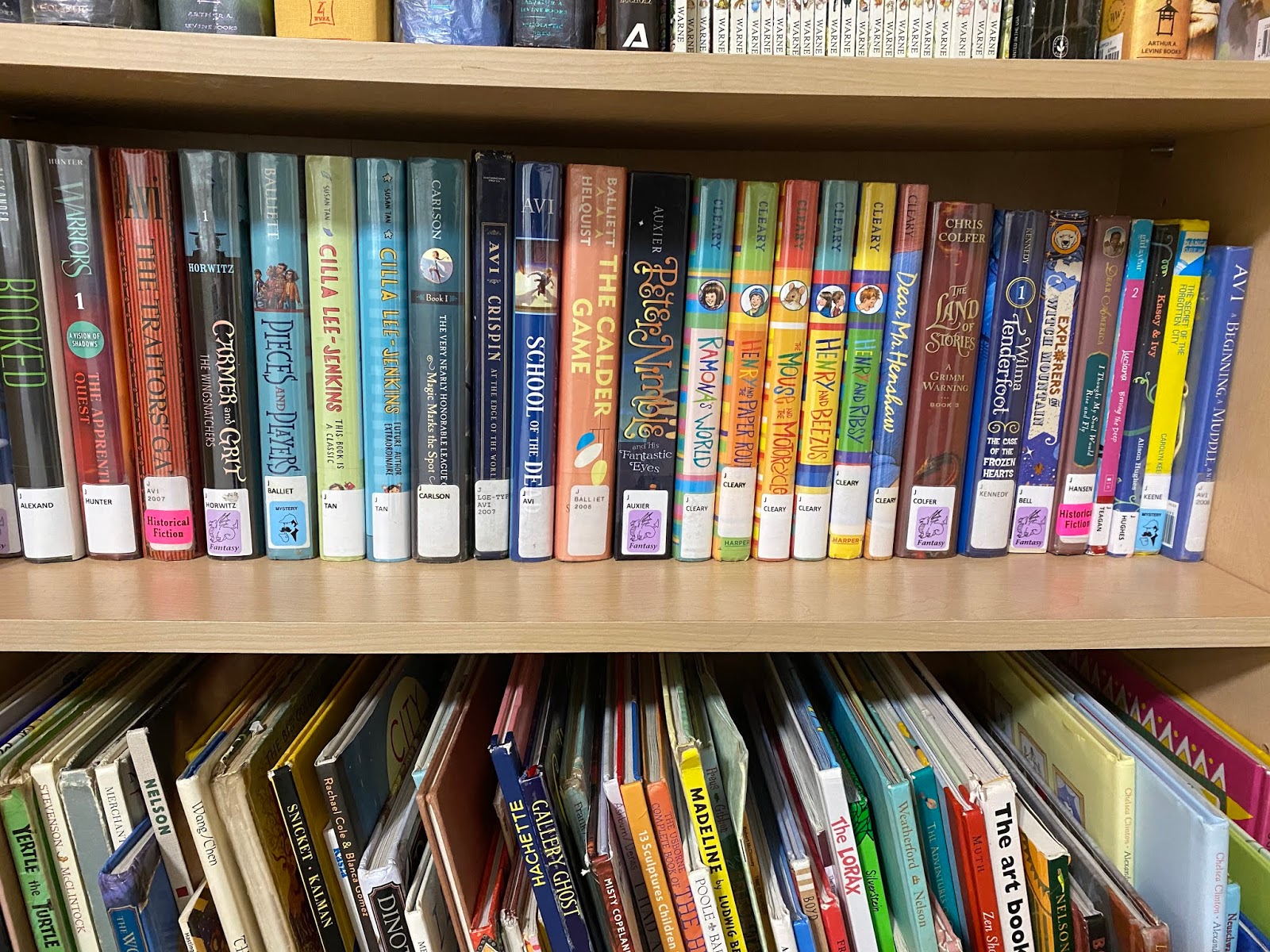 |
| Shelf 2 of library books |
 |
| Overflow in the basket that normally holds our library books |
Now the struggle is what to read first. Chloe and I are both midway through other books that we want to finish before we start on these. Good thing we now have so much reading time!
 |
| Shelf 3 of library book |
Thursday, March 12, 2020
Schooling in the Time of Coronavirus
UPDATE 3/13/20 Sno-isle libraries are closing today at 6pm and we don't know when they will reopon. You'll still be able to borrow digital content online but if you want some hard copy books, DVDs, or CDs, hurry today and get what you can!
Did you just find out your child’s school is going to be closed for 2 weeks or more?! I’ve heard some schools in Washington State are closing for as many as 6 weeks! Are you totally freaking out? Don’t worry that’s a normal reaction. But also, I’ve got you. It will be fine. It might even be fun.
Who am I? My name is Jennifer. I have been homeschooling my kids ages 11, 11, and 16 from the beginning. None of my kids have been to public school. To be clear, I am not opposed to public school and I’m really glad public schools exist. It isn’t what my family has chosen as our best option - but that’s just us. I truly don’t believe there is one right way to school. Each family can and should decide what is best for them. That said, I have some experience homeschooling kids. I have also coached a lot of moms who are figuring out how to homeschool their kids. 2 of my kids have special needs. 1 of them is on the autism spectrum. So I’ve had to figure out how to work with a variety of different circumstances.
Also, between my kids special needs and the Homeschool Group and co-op I help run (LEAF, if you’re curious) I basically have a full time job. So I feel you, working parents who now have to homeschool your kids on top of it!
Please note, all the advice I’m about to give is specific to this, short term, emergency situation. If you were just beginning homeschool and were planning to continue it for the next few months, I would have some different advice for you. Not wildly different, but different. If you happen to be contemplating homeschooling for more than a few weeks, check out this blog post I wrote a while ago.
Ok, so you have 3 or 4 days to prepare and then BAM! You’ll be homeschooling for at least 2 weeks, maybe longer. To begin with:
Little ones often enjoy playing while listening to an audiobook. While I enjoy reading aloud to my kids, I can’t do it for hours, and sometimes I really need to work so I can’t be the reader. Audiobooks to the rescue! Put an audiobook on and let the kids play (as quietly as they can). If you need suggestions, here is a list of favorites that I read to my oldest when she was 4-6 years old.
I also recommend the booklists on the Read Aloud Revival website. And the book Read Aloud Handbook by Jim Trelease has a giant booklist in it. You can get the e-book version right now but this is a book I personally want in hard copy. There are plenty of other great lists out there but you don’t have time for research so just try one or all of these.
So how do you get your kids to go on a reading binge? You let them choose what they want to read and you get the books for them. Fastest way to make sure it doesn’t happen is to require your kids to read specific books. But if you let them choose and they get sucked in, you’re golden. Try to help them find a series they are interested in reading. Series really help suck young readers in and keep them going. And seriously, the quality of the writing is not important. As long as the book doesn’t conflict with your values, the reading practice will be a game changer for your child. Is there a book series your child has shown interest in? Maybe something you’ve sniffed your nose at? Again, as long as it doesn’t conflict with your values, embrace it. This could be your child’s golden ticket. I’m not exaggerating. If you had the time, I’d tell you to go read the research. But you don’t.
Some popular series for middle-grade readers include
If your middle-grade child struggles with reading, I still hope they can find a series within their reading level that they can binge. It will make a massive difference for them. But if they aren’t capable of this yet or you just can’t get them inspired, audiobooks will be wonderful for them. Even better would be listening to the audio while following along in a hard copy of the book. This is also a good strategy for reading a book way above their reading level. Say for example, they really, really want to read Harry Potter but their reading level is well below that, they can listen to the book, It will do wonders for them.
I also highly recommend a binge of The Story of the World audio CDs by Susan Wise Bauer. Jim Weiss, my family’s favorite narrator, is the narrator for these CDs. Between the writing and the narrating, this series really turns history into a fascinating story. My kids have listened to the whole series multiple times. They LOVE it. I love hearing them talk about people from history like friends and acquaintances. My son regularly brings up the Visigoths and Ashurbanipal. Cracks us up. There are 4 volumes and each is 8 - 12 hours long. The whole set will cost well over $100. Worth it. Even if you only get one. Worth it. The library has them too but, get in line. There’s always a long wait for them.
Most kids can’t sit still while listening to an audiobook. If your kids are going to spend hours listening to books I recommend getting out legos, coloring books, art supplies, nail polish, fidgets and other things your kids could play with while they listen.
Kids this age would do well with their own kindles to listen to audio books on and to read on. Especially if you have multiple children and they all want to listen to different things, kindles with headsets are a lifesaver.
It could also be fun to read a book and then watch the movie. It could motivate reluctant readers if they know the whole family will watch the movie at the end of the day or week. Here’s a list of kids books made into movies. Harry Potter is the best one I can think of. I’m kind of a fan...
If you are struggling to keep kids busy and they aren’t falling into a reading binge. You could try
I recommend audio books for these students too. Any books they are interested in. These students can probably come up with their own quiet activities to do while listening but all the things I suggest for Middle kids would probably work for Biggest kids too.
All the other things I recommended for Middle kids, I also recommend for Biggest kids. These include
I’m excited for you and your kids to have this opportunity. I am aching for and worrying about all those who will suffer from missing out on school lunches and childcare while the school closures last. This is a huge problem and I don’t want to minimize it in any way. But, for those of you who are able to work from home and have the means to feed your children at home, this just might be one of the greatest experiences of your life. Embrace it! Good luck! I’m here if you have questions:)
Did you just find out your child’s school is going to be closed for 2 weeks or more?! I’ve heard some schools in Washington State are closing for as many as 6 weeks! Are you totally freaking out? Don’t worry that’s a normal reaction. But also, I’ve got you. It will be fine. It might even be fun.
Who am I? My name is Jennifer. I have been homeschooling my kids ages 11, 11, and 16 from the beginning. None of my kids have been to public school. To be clear, I am not opposed to public school and I’m really glad public schools exist. It isn’t what my family has chosen as our best option - but that’s just us. I truly don’t believe there is one right way to school. Each family can and should decide what is best for them. That said, I have some experience homeschooling kids. I have also coached a lot of moms who are figuring out how to homeschool their kids. 2 of my kids have special needs. 1 of them is on the autism spectrum. So I’ve had to figure out how to work with a variety of different circumstances.
Also, between my kids special needs and the Homeschool Group and co-op I help run (LEAF, if you’re curious) I basically have a full time job. So I feel you, working parents who now have to homeschool your kids on top of it!
Please note, all the advice I’m about to give is specific to this, short term, emergency situation. If you were just beginning homeschool and were planning to continue it for the next few months, I would have some different advice for you. Not wildly different, but different. If you happen to be contemplating homeschooling for more than a few weeks, check out this blog post I wrote a while ago.
Ok, so you have 3 or 4 days to prepare and then BAM! You’ll be homeschooling for at least 2 weeks, maybe longer. To begin with:
- Take a Deep Breath. The rest of your child’s future does not hang on these few weeks. Even if your kids do nothing productive the whole time, it won’t ruin them. Really. You may have heard of the summer slump, when kids regress academically after 2-3 months of no school. Yes, it’s a thing. But your kids probably won’t be out of school for 2-3 months. And even if they are, the summer slump can be mitigated by reading a few books. Really. All kinds of research on this. You don’t have time to look it all up so just trust me. I’ve read dozens of books on this and I’ve seen it in action.
- I’m gonna share lots of ideas. Think of this as a menu, not a checklist. You shouldn’t try to do it all. Pick a few things that resonate with you and try those out.
- You’re all gonna get a little cagey and house-bound. Make sure you all get outside, every day. Even if it’s just a family walk to the mailbox, get outside. Every. Single. Day. It will improve everyone’s mental health, it can help you all reset after a rough morning/afternoon/moment, and it will really help the kids with ADHD. I try to do school with my kids in the morning and encourage them to spend a lot of time outside in the afternoon, especially my son who has ADHD and autism. Trampoline time saves us all.
What to Do With Little Ones
With kids ages roughly 0-8 I recommend that you mostly let them play. There’s tons of research showing how beneficial creative/free-play is. Creative/free-play means the child decides what and how to play. Obviously within safety and household limits, but you don’t need to convince your child to play something specific. If your kids are out of practice, they might need a few hours of boredom to figure it out, but they will. Little ones often enjoy playing while listening to an audiobook. While I enjoy reading aloud to my kids, I can’t do it for hours, and sometimes I really need to work so I can’t be the reader. Audiobooks to the rescue! Put an audiobook on and let the kids play (as quietly as they can). If you need suggestions, here is a list of favorites that I read to my oldest when she was 4-6 years old.
I also recommend the booklists on the Read Aloud Revival website. And the book Read Aloud Handbook by Jim Trelease has a giant booklist in it. You can get the e-book version right now but this is a book I personally want in hard copy. There are plenty of other great lists out there but you don’t have time for research so just try one or all of these.
Where to get audiobooks?
- Most libraries have amazing selections of audiobooks that you can checkout and download online, for free.
- Librivox.com offers free public domain audiobooks. The quality of narrators can vary but it’s free so try a few out.
- I love my audible.com membership. I get a credit for one free audiobook every month (worth up to $42) and there are tons of inexpensive audiobooks (like under $5 each) available on audible.com. The Read Aloud Revival website keeps track of the deals and recommends good ones. It doesn’t take a lot of money or time to build a great audiobook library of your own. I also love that my audible account is connected to my Alexa so I can easily tell Alexa to play any of my audiobooks.
- CDs of anything narrated by Jim Weiss. Jim Weiss is hands down my family’s favorite narrator. My kids know his name and will listen to anything he narrates. A few of his recordings are starting to show up on audible but most of his work is only available on CD. Worth the hassle though, seriously. The sno-isle library system has dozens of his stories available. You can also buy them on amazon.com. You’ll need a CD player to play them on, but again, worth it.
What to Do With Middle ones
Kids between the ages of 8-14 would benefit most right now from a reading binge. No matter what reading level they are at right now, a reading binge is the best thing that could happen to them and it might change their lives. Many studies show over and over again, that lots of time spent reading increases test scores dramatically - in fact pages read is the best predictor of test scores! Reading books over the summer is more effective in eliminating the summer slump than summer school! And it doesn’t matter what the students read - it only matters that they read A LOT. If you need convincing check out The Read Aloud Handbook by Jim Trelease and all the work of Donalyn Miller (Book Whisperer, Reading in the Wild, Game Changer). But you don’t have time for that. So just trust me.So how do you get your kids to go on a reading binge? You let them choose what they want to read and you get the books for them. Fastest way to make sure it doesn’t happen is to require your kids to read specific books. But if you let them choose and they get sucked in, you’re golden. Try to help them find a series they are interested in reading. Series really help suck young readers in and keep them going. And seriously, the quality of the writing is not important. As long as the book doesn’t conflict with your values, the reading practice will be a game changer for your child. Is there a book series your child has shown interest in? Maybe something you’ve sniffed your nose at? Again, as long as it doesn’t conflict with your values, embrace it. This could be your child’s golden ticket. I’m not exaggerating. If you had the time, I’d tell you to go read the research. But you don’t.
Some popular series for middle-grade readers include
- Magic Treehouse
- Harry Potter
- Land of Stories
- Dork Diaries
- Babysitters Club
- I Survived
- American Girls
- Percy Jackson
- Fablehaven
- Alcatraz
- The Giver
- Eragon
If your middle-grade child struggles with reading, I still hope they can find a series within their reading level that they can binge. It will make a massive difference for them. But if they aren’t capable of this yet or you just can’t get them inspired, audiobooks will be wonderful for them. Even better would be listening to the audio while following along in a hard copy of the book. This is also a good strategy for reading a book way above their reading level. Say for example, they really, really want to read Harry Potter but their reading level is well below that, they can listen to the book, It will do wonders for them.
I also highly recommend a binge of The Story of the World audio CDs by Susan Wise Bauer. Jim Weiss, my family’s favorite narrator, is the narrator for these CDs. Between the writing and the narrating, this series really turns history into a fascinating story. My kids have listened to the whole series multiple times. They LOVE it. I love hearing them talk about people from history like friends and acquaintances. My son regularly brings up the Visigoths and Ashurbanipal. Cracks us up. There are 4 volumes and each is 8 - 12 hours long. The whole set will cost well over $100. Worth it. Even if you only get one. Worth it. The library has them too but, get in line. There’s always a long wait for them.
Most kids can’t sit still while listening to an audiobook. If your kids are going to spend hours listening to books I recommend getting out legos, coloring books, art supplies, nail polish, fidgets and other things your kids could play with while they listen.
Kids this age would do well with their own kindles to listen to audio books on and to read on. Especially if you have multiple children and they all want to listen to different things, kindles with headsets are a lifesaver.
It could also be fun to read a book and then watch the movie. It could motivate reluctant readers if they know the whole family will watch the movie at the end of the day or week. Here’s a list of kids books made into movies. Harry Potter is the best one I can think of. I’m kind of a fan...
If you are struggling to keep kids busy and they aren’t falling into a reading binge. You could try
- Crash Course kids on youtube. This is a well done PBS series covering all kinds of science topics. Just beware of all the commercials and additional content that will be tempting your kids. Youtube’s algorithm is designed to entice people to stay on as long as possible and this is accomplished by offering more and more extreme content to the viewer (on the side in the “up next” column). I recommend turning autoplay off and keeping a close eye on kids while they use youtube.
- Documentaries on Kanopy This site offers all kinds of documentaries. You should be able to get free access to it through your library.
- Documentaries on youtube. There are some cool ones on there like the one where they build a medieval castle from scratch without any modern technology. Just do a search. And keep a close eye on the kids while they are on youtube.
- Educational TV shows. No, this isn’t as good as school, but it’s better than you losing your mind or your job and it’s far better than mindless TV. Some series my kids have enjoyed and that I find value in
- Magic School Bus
- Annedroids
- Odd Squad
- Wild Kratts
- I know there are others, search amazon and netflix and you’ll find them
- Khan Academy online. It’s free, there are courses on dozens of subjects, not just math, and the instructional videos are pretty great. Khan keeps kids engaged with reminders to do it every day, and virtual rewards for mastering content and keeping a streak going. I’m amazed at how motivating and effective it is.
- Typing.com. Free and very effective way to work on keyboarding skills. My kids enjoy it.
- Duolingo.com. Free, fun, and effective way to learn languages. My kids love it.
- Code.org. Free, fun, and a great launchpad into coding. I hear that Khan Academy has more advanced coding for those who max out code.org.
- Board games and card games. Tons of learning happens with games. Lots of reading and math are usually required and more importantly lots of strategizing and problem solving which will translate to academics.
- Get an email pen-pal. Practice typing and writing skills and connect with a grandparent, cousin, friend etc. over email.
What to Do With Biggest ones
For students ages 14-18 A reading binge would be amazing, maybe life changing. It will definitely improve their test scores. There are tons of series that would be perfect for these students too. Here’s a few I recommend- The Giver series by Lois Lowry
- The Mistborn series
- everything written by Brandon Sanderson (He has multiple series and really sucks readers in)
- The Hunger Games series
- Uglies, Pretties, Specials series
- Enders Game series and Ender’s Shadow series
I recommend audio books for these students too. Any books they are interested in. These students can probably come up with their own quiet activities to do while listening but all the things I suggest for Middle kids would probably work for Biggest kids too.
All the other things I recommended for Middle kids, I also recommend for Biggest kids. These include
- Khan Academy online
- Typing.com
- Duolingo.com
- Code.org
- Board games and card games
- Email pen-pal
I’m excited for you and your kids to have this opportunity. I am aching for and worrying about all those who will suffer from missing out on school lunches and childcare while the school closures last. This is a huge problem and I don’t want to minimize it in any way. But, for those of you who are able to work from home and have the means to feed your children at home, this just might be one of the greatest experiences of your life. Embrace it! Good luck! I’m here if you have questions:)
Friday, February 01, 2013
The Lost Boys: Harry, Severus, and Tom
The Lost Boys:
Harry, Severus, and Tom
Today in my Harry Potter class we are looking at the lives of Harry, Severus Snape, and Tom Riddle and comparing their circumstances, choices, and outcomes. I hope it will be a thought provoking experience for the kids. We're going to use a big roll of butcher paper and big sharpies to write down and compare each of the boys circumstances and choices at birth, during childhood, when they arrived at Hogwarts, during their beginning years at Hogwarts, during their final year at Hogwarts, after they left Hogwarts, and the outcomes of their lives. We'll begin by reading my favorite quote by C.S. Lewis from his essay, The Weight of Glory. I think the Harry Potter series is an amazing exploration of the idea that we all have the potential to become gods or monsters. As Dumbledore puts it, it is our choices far more than our abilities that determine who we are. But, as Lewis points out, our circumstances, especially the actions of others around us, can help us go one way or the other. We all ought to consider which way we are helping our fellow men to go.
From C.S Lewis's The Weight of Glory:
“It is a serious thing to live in a society of possible gods
and goddesses, to remember that the dullest and most uninteresting person you
can talk to may one day be a creature which, if you say it now, you would be
strongly tempted to worship, or else a horror and a corruption such as you now
meet, if at all, only in a nightmare.
All day long we are, in some degree, helping each other to one or other
of these destinations.”
Circumstances and Choices
Born to
H: Pureblood father, muggleborn mother, parents loved each
other and him
S: Pureblood mother, muggle father, parents fought a lot
T: Pureblood mother, muggle father, mother tricked father
into marrying her, when father realized he left her
Raised
H: By his Aunt and Uncle who didn’t love him and treated him
horribly
S: By his constantly fighting parents who didn’t seem to
love him
T: In an Orphanage by people who initially pitied him, then
came to fear him and didn’t love him
Childhood choices
about how to treat others
H: Wished for friends, tried to avoid being mistreated by
his cousin, uncle, aunt and kids at school. He was generally polite to everyone he came in contact with.
S: Tried to be friends with Lily but was unkind to her
sister, Petunia. He wanted to have
friends and love but he wasn’t nice to everyone and he was sometime deceitful
T: Never sought friends. His goal was to have power over the
other children around him. He
tormented them and made them fear him.
Circumstances when
they arrived at Hogwarts
H: Had recently learned he was a Wizard and that his parents
had been murdered. He had plenty
of money. He didn’t know anything
about magic or the Wizarding World.
S: Knew he was a wizard. He was very poor.
He knew a lot about the Wizarding World and a little bit of magic.
T: Had recently learned he was a Wizard, confirming his
belief that he was special and different from his peers at the Orphanage. He was very poor. He didn’t know anything about the
Wizarding World and had figured out how to do some magic.
Choices in their
beginning years at Hogwarts
H: He asked the
sorting hat to put him in Gryffindor and not in Slytherin. He quickly made friends with Ron and
Hermione. He was loyal to Hagrid
and cherished his friendship too. He
rejected Malfoy’s offer of friendship, power, and popularity. He generally treated his classmates and
teachers with kindness and respect.
He was anxious to learn about the Wizarding World. He defended Neville when Malfoy was
bullying him. He helped Hagrid solve
lots of problems. He made enemies
of Malfoy and Professor Snape. He
fought evil when he saved the Sorcerers Stone, Defeated the Heir of Slytherin,
and defeatedthe Basilisk in the Chamber of Secrets. He saved lots of lives including, Ginny’s Life, Sirius’s
life, and even Peter Pettigrew’s life.
He fought injustice by helping to clear Hagrid’s name so he could leave
Azkaban, helping Sirius escape, and prevented Lockhart from leaving Ginny in
the Chamber of Secrets.
S: Tried to be
Lily’s friend and be friends with the kids who would one-day become Death
Eaters. He hated James Potter and
all James’s friends. He tried to
convince Lily to hate them too while she tried to convince him to abandon his
Slytherin friends. He learned a lot
of dark magic.
T: He wasn’t a real friend to anyone. He built a group of followers who he
promised power and influence. They
would eventually become his Death Eaters.
He learned as much as he could about they History of the Hogwarts
Founders and about his own heritage.
He learned a lot of dark magic.
Choices in Their
Final Years at Hogwarts
H: He was loyal to his friends and to the truth even though
it meant sacrificing popularity, reputation, and comfort. He started Dumbledore’s Army in
an effort to defend the truth and to prepare his friends and classmates to
fight against evil. He told the
truth about Cedric’s death and Voldemort’s return. He chose love instead of
hate.
S: He was cruel
to Lily and lost her friendship.
He committed himself to the path that would lead him to become a Death
Eater. He chose hate and became
totally bitter.
T: He learned that he was the Heir of Slytherin, the truth
about his parent’s relationship.
He chose hate and murdered his father and grandparents and started making
Horcruxes.
Choices After They
Left Hogwarts
H: He found and destroyed Voldemort’s horcruxes. He sacrificed his own life to save the
world and then was resurrected. He
defeated Voldemort. He remained
close with his childhood friends, married Ginny and had 3 children with
her. He named his sons after
Dumbledore and Snape.
S: He became a
Death Eater. He told Voldemort
about the prophecy he overheard which led Voldemort to murder Harry’s
Parents. Motivated by his love for
Lily he repented of his evil ways and became a double agent working for
Dumbledore against Voldemort.
Though he really disliked Harry and was never kind to him he devoted his
life to saving Harry’s. He was
murdered by Voldemort as part of
his effort to protect Harry and his last act was to give Harry his memories
which contained all the information Harry needed to finish defeating
Voldemort. These memories
also contained a lot of personal information about Snape that would probably have
embarrassed him.
V: He became
the Dark Lord, Voldemort and recruited the Death Eaters. He made his Horcruxes. He led the Death Eaters in a campaign
of terror and murder. After his second rise to power, he was
finally defeated by Harry Potter.
Ultimate Outcomes of
Their Choices
H: He had a lot
of friends and family. He was able
to defeat evil and protect his friends and family. He was happy and loved. He knew that when he died he would rejoin his parents and
friends who had already died, in a happy place.
S: He had no
friends or family. He suffered a
lot knowing it was his fault Lily died.
He was able to protect Harry and help him defeat Voldemort. He died knowing he was doing a good
thing. Harry came to respect him
tremendously and may have even felt love for him. We don’t know where he went after he died but Harry implied
that even Voldemort could have been saved if he had felt some remorse and
repented of his evil deeds so it is likely that Snape was able to be in a happy
place with people who respected him and maybe even loved him.
T: He had no
friends or family. He devoted his
life to evil and to becoming immortal.
In the end he killed himself when the killing curse he was aiming at
Harry rebounded on him. No one respected or loved him. After death, he was probably miserable like
the ugly horcrux baby Harry saw at Kings Cross.
Discussion Questions
1.
What did the 3 boys have in common?
2.
What were some of the differences between them?
3.
Who loved each of the boys and who did they
love?
4.
Do you think the 3 boys all had the potential to
become either gods or monsters?
5.
What did they each become in the end?
6.
Was Harry’s life happy? Was it easy or hard?
7.
Snape became good in the end but was his life
happy? What did he miss out
on? What did he gain by repenting?
8.
Was Voldemort’s life happy? Was he happy after he died? What were the benefits of his choices?
9.
Were their circumstances or their choices more
important in determining what each boy became?
10.
From The Chamber of Secrets, p. 333
Do you think this is true? Why or why not? “It is our choices, Harry, that show what we truly are, far
more than our abilities.”
11. Who
helped each of the boys become gods or monsters?
Tuesday, July 17, 2012
Family Builder Seminar in Mukilteo, WA
I'm so excited to announce this! This fall, September 29, to be exact, I am hosting a Family Builder seminar. Here's a link to the seminar registration info.
It will be in Mukilteo, WA. Family Builder is the program Diann Jeppson and Jodie Palmer run to support family centered education. This seminar is 1 day long and very reasonably priced. Look at the agenda - I think it sounds pretty amazing and it will give you a good idea about whether or not this one is for you. The room I booked only has space for 50 people so register ASAP to make sure you get a spot.
It will be in Mukilteo, WA. Family Builder is the program Diann Jeppson and Jodie Palmer run to support family centered education. This seminar is 1 day long and very reasonably priced. Look at the agenda - I think it sounds pretty amazing and it will give you a good idea about whether or not this one is for you. The room I booked only has space for 50 people so register ASAP to make sure you get a spot.
Tuesday, May 29, 2012
How Does Your Garden Grow?
I recently had an amazing conversation with a friend that
led us to a shared epiphany. As homeschooling TJEDers, we are both frequently
asked to compare our homeschooling to public school and to more common K-12
homeschooling. My friend and I
were talking about the differences and I was having a particularly hard time
comparing what I do with typical education. “Homeschooling” didn’t cover everything I meant when I used
the word “education.”
As we talked we acknowledged that the goal of Leadership
Education is for a person to realize their full potential while the goal of
typical education in the U.S. is for a person to realize their academic
potential.
Our shared epiphany was this: It is impossible to compare what we are doing – Leadership Education –
to typical education because Leadership Education is concerned with the whole
person while typical education is only concerned with a small part of a person.
It is like comparing holistic medicine to brain
surgery. As a former brain surgery
patient, I can sincerely say that I understand how critical a brain surgeon is
and I’m so grateful for the surgeon who saved my life. But it would be ludicrous of me to
ignore all the other systems in my body and assume that brain surgery would
ensure my entire body’s physical health.
Just as there is more to my body
than my brain, there is more to a person than their academic potential. All the people I know understand
this. I suspect there are very
few, if any, people who don’t understand this. Sadly, society in general
doesn’t live in accordance with this truth. Many, many parents, teachers, and
students are trying to live this truth.
I love Leadership Education
because it embraces this truth. It
is teaching me how to live it.
Typical education may begin as early as pre-school and end
after high school, college, or graduate school. Ideally Leadership Education begins at birth and continues
throughout a person’s whole life – it is never finished. Typical education
happens during school hours and usually in a classroom. As soon as the bell rings or the
student leaves the classroom, education is done for the day. Leadership
Education happens 24-7 wherever the student’s body is at.
As my friend and I talked we started to use an analogy,
probably inspired by Oliver and Rachel DeMille’s beautiful poem about an Oak
Tree (on the back cover of the book Leadership Education). We compared our children to
little plants that we were raising.
We’d already helped them get from seed to tiny plant but we both know
our little plants have a long way to go.
Ever since that conversation I
have started thinking of my children as little plants and myself as a gardener
of children. My goal is to
give my little plants the environment and nurturing they need to grow and
develop and become whatever plant they were meant to be. Each one is unique. They are not all going to become the
same kind of plant. They have
unique needs and unique development paths. I’m certain academics will be something each of them need at
some point, likely many points, along the way, but that is just a portion of
their development. Especially with
my core phasers, academics aren’t a high priority at all.
At the beginning of
the week I try to look at my little plants in my minds eye and ask myself, what
do they need this week to grow and develop? Then each day I try to ask again, which things do they need
most today? This week, what comes
to mind is my 3 yo daughter needs opportunities to work alongside me with jobs
like picking up toys and emptying the dishwasher; lots of snuggle time;
opportunities to improve her hand coordination with activities like coloring
and cutting; and our daily devotional.
Thinking of my 3 yo son, I know right now he needs lots of Dad time;
opportunities to climb and run and jump; recognition of all his good choices;
and our daily devotional. As I
think of my 8 yo daughter I know she needs more sleep; my help purging and
reorganizing her bedroom; opportunities to talk with me; one-on-one time with
Dad; time to ride her bike; lots of time to work with or near me; to be read to
by me; time to read and “play” with the academic subjects she is interested in;
time to socialize with friends at least a couple hours/week; opportunities to
learn more beginning cooking skills; inspiration to read our core book on her
own; and our daily devotional.
This is what I think my little plants need right now. Some of what I think they need is
constant, like our daily devotional.
But most of what I think they need changes with each week, month, and
season of the year. We are
transitioning right now from our “school year” to our “summer.” For my core-phasers, the big difference
will be not going to physical therapy for 3 months and going to weekly park days, but other than that, life will feel pretty much the
same for them. For my
love-of-learning-phase daughter, there are more noticeable differences. The clubs she participates in have
ended or will end soon for a summer break. Now that our Seattle weather is getting warmer and dryer (relatively),
we can spend a lot of time outside and park day with our friends will be what
we look forward to all week.
I won’t be involved in as many of my book clubs and classes so we’ll
have more family time and a simpler schedule. Our daily work will change in response to the change in
season. There will be lots of food
preservation, vacation planning and prep, planning for the next school year,
and yard work. Meal preparation
will be focused more on washing and cutting up produce and won’t involve the
oven, crock-pot, or stove much.
I’m sharing a little slice of my family’s life right now but
it will look different next week and completely different in 3 months. Kind of the way a garden looks so
different each season and the gardener’s work is different from day to
day.
Tuesday, February 21, 2012
Amateur Art Study
I love art and casually study it on my own. I know just enough to know I don’t know much at all. The more I get into it though, the more addicting I find it. My limited study of Art has really helped me enjoy and get more out every other subject I study. Here are some of my favorite books and DVDs for learning about Art and sharing it with my family:
For Kids
The Katie series of picture books by James Mayhew
The Art Book for Children series by Phaidon publishers
Mary Ann F. Kohl’s series of books on Art Projects that combine Art with other subjects, like, math, science, history, etc. http://www.amazon.com/s/ref=ntt_athr_dp_sr_1?_encoding=UTF8&sort=relevancerank&s\
Usborne Books on Art (there are a lot, these are just a couple examples)
For Youth
For Adults
My name is Asher Lev and The Gift of Asher Lev by Chaim Potok
Letters to His Son Lucien (letters written by Camille Pissaro)
Great Courses DVD classes on art like these:
The PBS series Great Museums, you can watch it on Hulu.com
Parents and teachers please note, the Art Tradition includes an extensive study of The Nude. This means most art books and classes, even some of those designed for children, will include pictures of and descriptions of nudes. Generally, I appreciate artists’ appreciation of what I consider, God’s greatest creation, the human body. There are some artists and works that cross the line, in my opinion, and objectify rather than glorify the body. I recommend that you carefully consider the books and DVDs on art that you want to bring into your home and/or present to children. I’ve grouped my favorite books and DVDs on Art into 3 lists, based on who I think they are appropriate for but you should review them and decide what you think – don’t take my word for it.
I recommend students of all ages visit art museums as often as you can. Many museums are free and almost all of those that charge have one day or evening a month when admission is free. This is when I take my children so that a half hour doesn't feel like a waste of money. The more one is surrounded by art, the more familiar it becomes and the easier it is to learn about and enjoy.
Subscribe to:
Comments (Atom)


 Posts
Posts